Single-stage beam-driven acceleration in quasi-3D cylindrical geometry (using QPAD)
This page describes how to run a single-stage beam-driven acceleration simulation in quasi-3D cylindrical geometry, using the quasi-static code QPAD.
For more details on the features of QPAD and how it compare to other codes, see Validity of the Different Codes.
Overview
This example showcases the hosing instability in a two-bunch, single-stage PWFA with transverse offsets. In this example, a narrow 3 nC drive bunch excites a plasma wakefield in the nonlinear blowout regime. A 1 nC trailing bunch behind the driver is initially offset transversely by 2 microns and undergoes hosing as the slice centroid oscillations grow. Both beams are tri-gaussian and the plasma density profile is longitudinally and transversely uniform. Some additional features of this example include:
Beam loading: The witness bunch is positioned at the appropriate phase of the wake (~ 300 um behind the driver) so that it flattens the accelerating field near the beam center. This helps preserve the energy spread of the witness bunch.
Matching: Beams are matched to the plasma so that their spot sizes do not oscillate.
Quasi-3D Algorithm: QPAD has a quasi-3D algorithm that uses PIC in r-z and a gridless azimuthal fourier mode expansion, \(\rho(r,\phi,z) = \Re\left[\sum_m \rho_m(r,z) e^{im\phi}\right]\), to describe the fields and sources. It enables modeling of full-3D physics (e.g. offsets, asymmetries) at a fraction of the computational cost. For more details on the quasi-3D, quasi-static algorithm see here.
Note
Use enough azimuthal particles to resolve the highest mode \(m\). As a rule-of-thumb, using \(ppc_{\phi} \geq 8m\) is recommended
Particle-in-Cell Modeling Interface (PICMI): This example uses the Particle-in-Cell Modeling Interface standard to generate input decks and run simulations from python. The PICMI standard establishes a common set of naming conventions and interfaces to run simulations across different codes. More info on can be found here.
Note
- If needed, install the picmi-standard in terminal by typing
pip install picmistandard
Installation
QPAD is open-source, and available on Github
Installation instructions for QPAD are available here.
Simulation script
You can download the required files by clicking on hosing_sim_qpad.py and picmi_qpad.py. Store these files in a folder where you want to run your simulation and cd into it. Run the simulation script in terminal by typing:
python hosing_sim_qpad.py
The script takes about 10 minutes to run on 16 CPU cores.
import sys
import os
import numpy as np
import h5py
import matplotlib.pyplot as plt
import shutil
import importlib
import json
import subprocess, os
import picmi_qpad as picmi


cst = picmi.constants
codename = picmi.codename
#################### simulation reference density ####################
n0 = 1e16 * 1e6 # number density in units of 1/m^3
wp = np.sqrt(cst.q_e**2 * n0/(cst.ep0 * cst.m_e))
kp = wp/cst.c


#################### grid params (in units of c/wp) ####################
zmin,zmax = -6.6/kp, 3/kp
rmin, rmax = 0, 9.395847/kp
nr, nz = 256, 512
n_modes = 1


#################### time step params (in units of 1/wp) ####################
dt = 10/wp
tmax = 20000.1/wp
ndump_diag = 10 # dump every 10 timsteps


#################### MPI_config ####################
cpu_split = [1,16] # QPAD cpu split


#################### drive beam params ####################
beam1_charge = 3.193e-9 # charge [C]
beam1_sigmas = [7.285e-6, 7.285e-6, 2.549e-5] # sigmas [m]
beam1_centroid_position = [0,0,0] # centroid at (0,0,0)


#################### trailing beam (#2) params ####################
beam2_charge = 0.956e-9 # charge [C]
beam2_sigmas = [7.285e-6, 7.285e-6, 1.274e-05] #sigmas [m]
beam2_centroid_position = [2e-6, 0, -3e-4] # offset 2 micron in x, behind driver by 300 um


#################### common beam params (shared by both beams) ####################
gamma = 19569.47 # Energy [10 GeV]
beta= np.sqrt(2 * gamma)/kp # matched condition
rms_vel = [beam1_sigmas[0] * gamma/beta, beam1_sigmas[1] * gamma/beta, 0] # matched condition


#################### Plasma profile ####################
plasma_density = n0 # uniform density


#################### PICMI section ####################
solver_dict, beam_dist_dict, plasma_dist_dict, part_diag_dict= {}, {}, {}, {}
beam_layout_dict, plasma_layout_dict = {}, {}
field_diag_dict = {}
sim_dict = {codename + '_nodes' : cpu_split, codename + '_n0' : n0}

# layouts of beams+plasma
ppc_beam = [2, 1, 2] # (2,2) ppc along (r,z), second index skipped
ppc_plasma = [4, 1] # 4 part per cell in r, second index skipped
num_theta_beam = num_theta_plasma = 8


#################### mkdir sim folder ####################
sim_dir= 'hosing_sims/' + codename + '_sim'
os.makedirs(sim_dir, exist_ok = True)


# initialize grid
grid = picmi.CylindricalGrid(
			number_of_cells           = [nr, nz],
			lower_bound               = [0. , zmin],
			upper_bound               = [rmax, zmax],
			lower_boundary_conditions = ['open', 'open'],
			upper_boundary_conditions = ['open', 'open'],
			n_azimuthal_modes = n_modes,
			moving_window_velocity    = [0,cst.c])


solver = picmi.ElectromagneticSolver( grid = grid , **solver_dict)


## add drive beam
drive_dist = picmi.GaussianBunchDistribution(
	n_physical_particles = abs(int(beam1_charge/cst.q_e)),
	rms_bunch_size       = beam1_sigmas,
	rms_velocity         = [cst.c * x for x in rms_vel],
	centroid_position    = beam1_centroid_position,
	centroid_velocity    = [0, 0, gamma*cst.c], **beam_dist_dict )

drive_beam = picmi.Species( name = 'drive', particle_type = 'electron', initial_distribution = drive_dist)


## add trailing beam
trailing_dist = picmi.GaussianBunchDistribution(
	n_physical_particles = abs(int(beam2_charge/cst.q_e)),
	rms_bunch_size       = beam2_sigmas,
	rms_velocity         = [cst.c * x for x in rms_vel],
	centroid_position    = beam2_centroid_position,
	centroid_velocity    = [0, 0, gamma*cst.c], **beam_dist_dict )

trailing_beam = picmi.Species(name = 'trailing', particle_type = 'electron', initial_distribution = trailing_dist)


# add plasma density
plasma_dist = picmi.UniformDistribution(density = plasma_density)

plasma = picmi.Species(particle_type = 'electron',
						name = 'plasma',
						initial_distribution = plasma_dist)

# beam/plasma layouts
beam_layout_dict[picmi.codename + '_num_theta'] = num_theta_beam
beam_layout = picmi.GriddedLayout(
		grid = grid,
		n_macroparticle_per_cell = ppc_beam,
		**beam_layout_dict)


plasma_layout_dict[picmi.codename + '_num_theta'] = num_theta_plasma
plasma_layout = picmi.GriddedLayout(
			grid = grid,
			n_macroparticle_per_cell = ppc_plasma,
			**plasma_layout_dict)


field_diag = picmi.FieldDiagnostic(data_list = ['E','rho'],
	                                   grid = grid,
	                                   period = ndump_diag,
	                                   **field_diag_dict)

part_diag = picmi.ParticleDiagnostic(period = 1,
                                     species = [drive_beam, trailing_beam],
                                     **part_diag_dict)


sim = picmi.Simulation(solver = solver, verbose = 1,\
	 time_step_size = dt, max_time =tmax,  **sim_dict)


sim.add_species(species = drive_beam, layout = beam_layout)
sim.add_species(species = trailing_beam, layout = beam_layout)
sim.add_species(species = plasma, layout = plasma_layout)
sim.add_diagnostic(field_diag)
sim.add_diagnostic(part_diag)


sim.write_input_file(sim_dir + '/qpinput.json')


# PATH to executable (qpad.e,...)
path_to_exe = ''   # <---- specify path to executable here
assert path_to_exe, Exception('Need to specify path to ' + picmi.codename + ' executable')

# optionally run the code use srun or mpirun
if(True):
	env = dict(os.environ)
	procs = np.prod(cpu_split)
	f = open(sim_dir + '/output.txt', "w")
	f2 = open(sim_dir + '/stderr.txt', "w")
	subprocess.run(["mpirun", "-n", str(procs), path_to_exe + "qpad.e"],stdout =f,stderr =f2, cwd = sim_dir, env=env)
	# subprocess.run(["srun", "-n", str(procs), "-c", str(2), "--cpu_bind=cores", path_to_exe + "qpad.e"],stdout =f,stderr =f2, cwd = sim_dir, env=env)
	f.close()
	f2.close()
Warning
- Make sure to modify the path to your qpad executable in the above script.
path_to_exe = '' # <---- specify path to executable here
Visualization and postprocessing
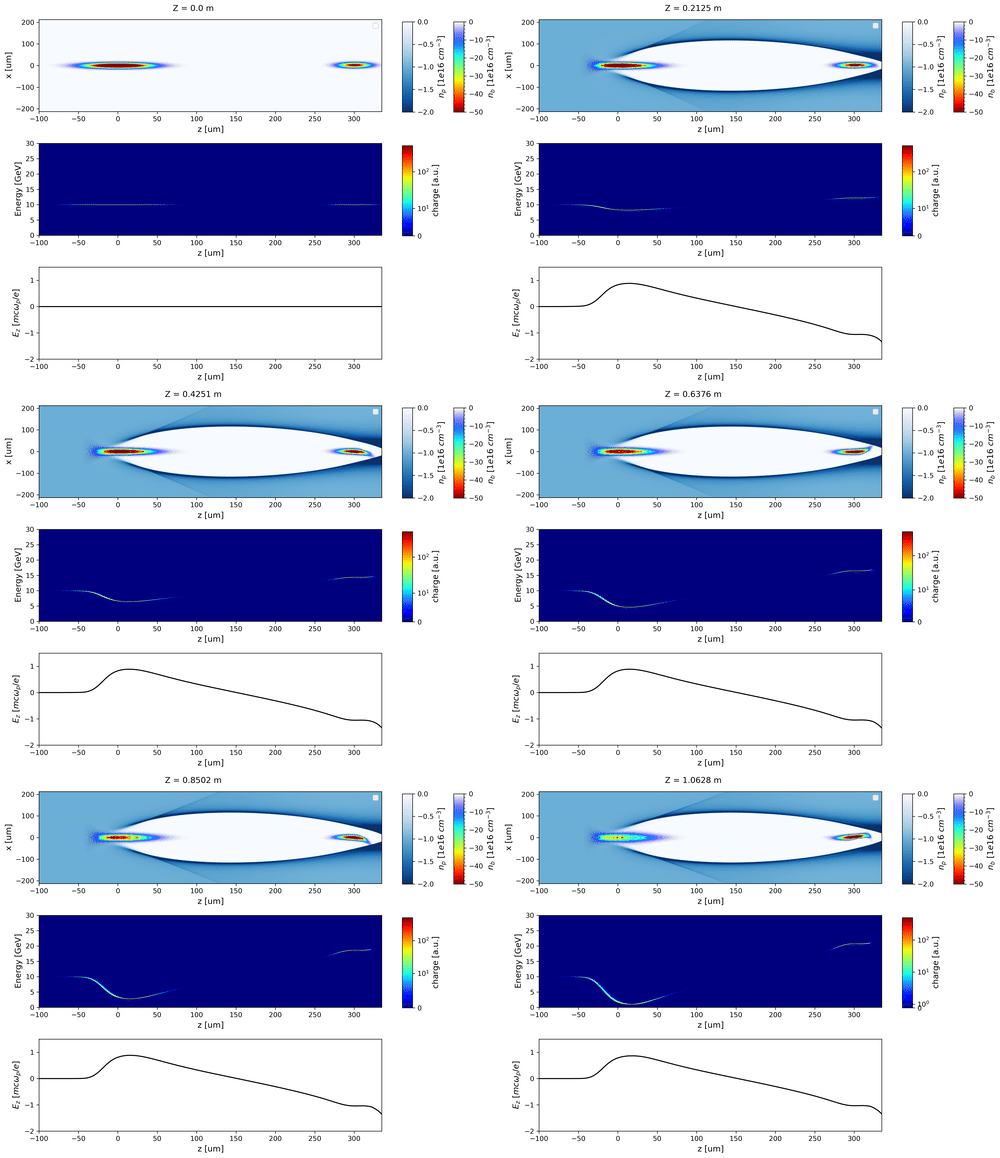
Here’s a gif showing the output of this simulation.
Warning
This section needs to be completed.